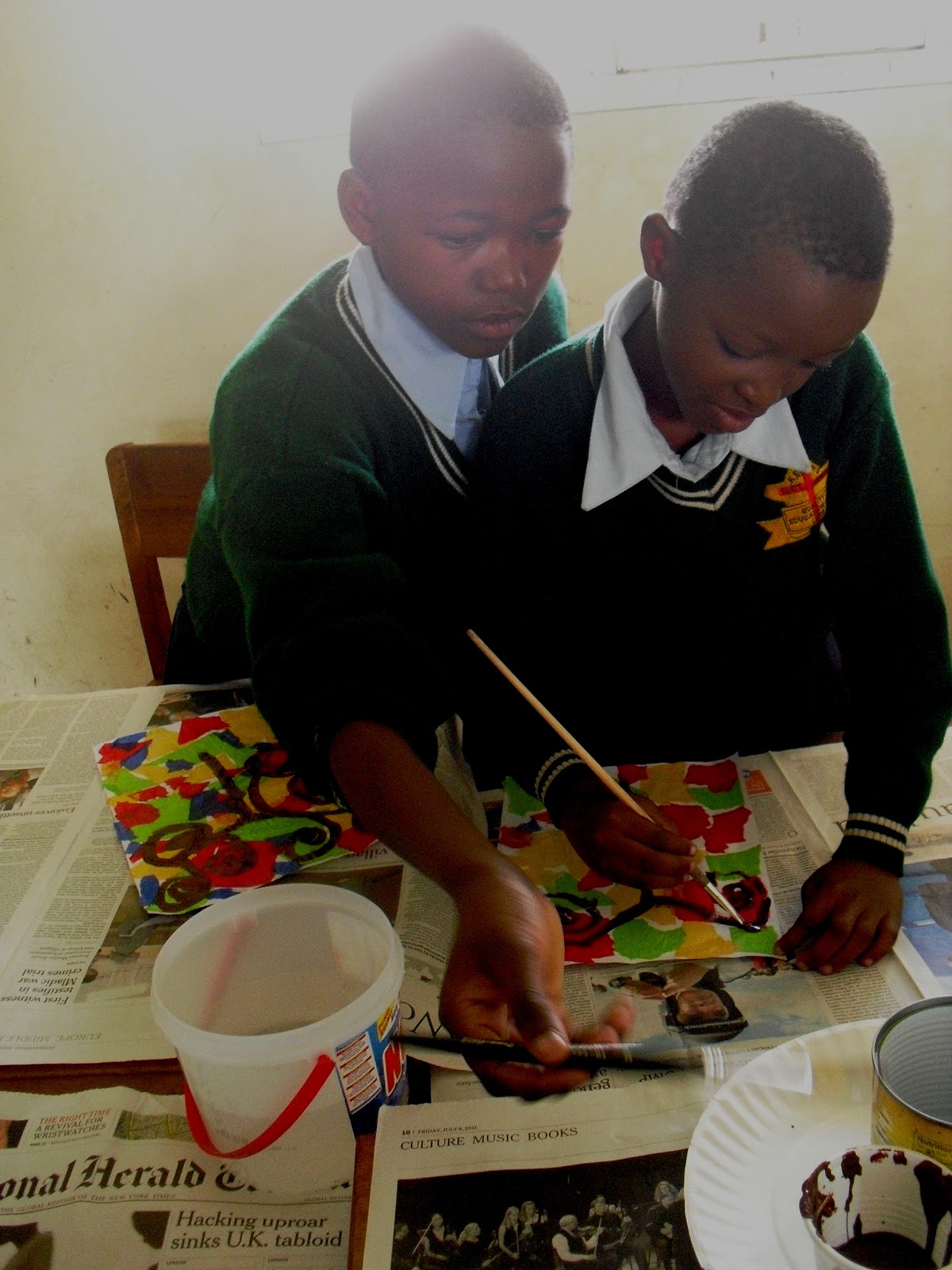
Standard 3 has been studying Gustav Klimt in Art for the past couple of weeks. In particular, we have focused on his painting "The Tree of Life". We talked about the different colours he used in this painting, as well as the shapes and how he simplified his tree to swirls to make the branches. Then each pupil created their own trees of life. They started by using glue, paintbrushes and tissue paper to create a warm and shiny background. Then they used brown, bronze and white paint to create the trunks, curled branches and roots of their trees. They added dots and circles to their paintings to create intricacies just like in Klimt's paintings.
Gluing down tissue paper and using paintbrushes for the first time.
Beginning to paint trees.
Erick working on his swirling branches.
Livinus looking very happy with using paint!
Adding details and different colours to finish her painting.
Ready to let the car go. After it has stopped
moving, they measured how far it traveled.
The past several weeks, Standard 6 has been busy with
experiment projects. The goal of the
project was to have smaller groups of students conduct an experiment on their
own, write a lab report, create a poster about their experiment, present it to
the class and share their work with the teachers during a poster fair.
The groups conducted different experiments. Two groups explored the amount of friction created
by different floor surfaces. They released toy cars from the top of ramps and then measured how far the toy car traveled on concrete, a mat, and a carpet. They did several trials and averaged their results. They created a bar graph of their results, and discussed whether their results supported their hypothesis, and what experiment they could do next to further explore friction.
Two other groups explored cohesion by using a plastic pipette to see how many drops of different liquids they could fit on a Tanzanian coin. They were very surprised that a coin could hold so many drops of water.
Pupils counted the number of drops of water,
vinegar and oil that could fit on a coin.
Other groups measured reaction times by seeing how quickly
volunteers caught a dropped ruler. Two groups compared average results for boys and girls in Standard 6, and two groups also compared reaction times of teachers to pupils in Standard 6. They were very good at making sure that every volunteer's hands were the same distance apart and that they dropped the ruler from the same point each time so that their results were accurate!
The last two groups explored how our ingrained ability to read interferes with the speed
with which we can name colors of letters if the word spelled by the letters is a different color. Not quite clear? Give it a try! Name the color of the letters of the words below. Don't read the words.
brown
green
purple
red
Now try to name the colors of the letters below. Don't read the words!
The volunteer waits to catch the ruler. The
centimeter at which they catch it will tell
how quickly they react.
brown
green
brown
red
Pupils timed how long it took volunteers to name the color of
the letters of a word (not read the word).
During their experiments, pupils learned how to use
plastic pipettes, had fun rolling toy cars down ramps, and asking teachers to
catch rulers and name colors of letters where the word was a different
color. Not only did pupils complete the experiments with enthusiasm, teachers participated eagerly as well.
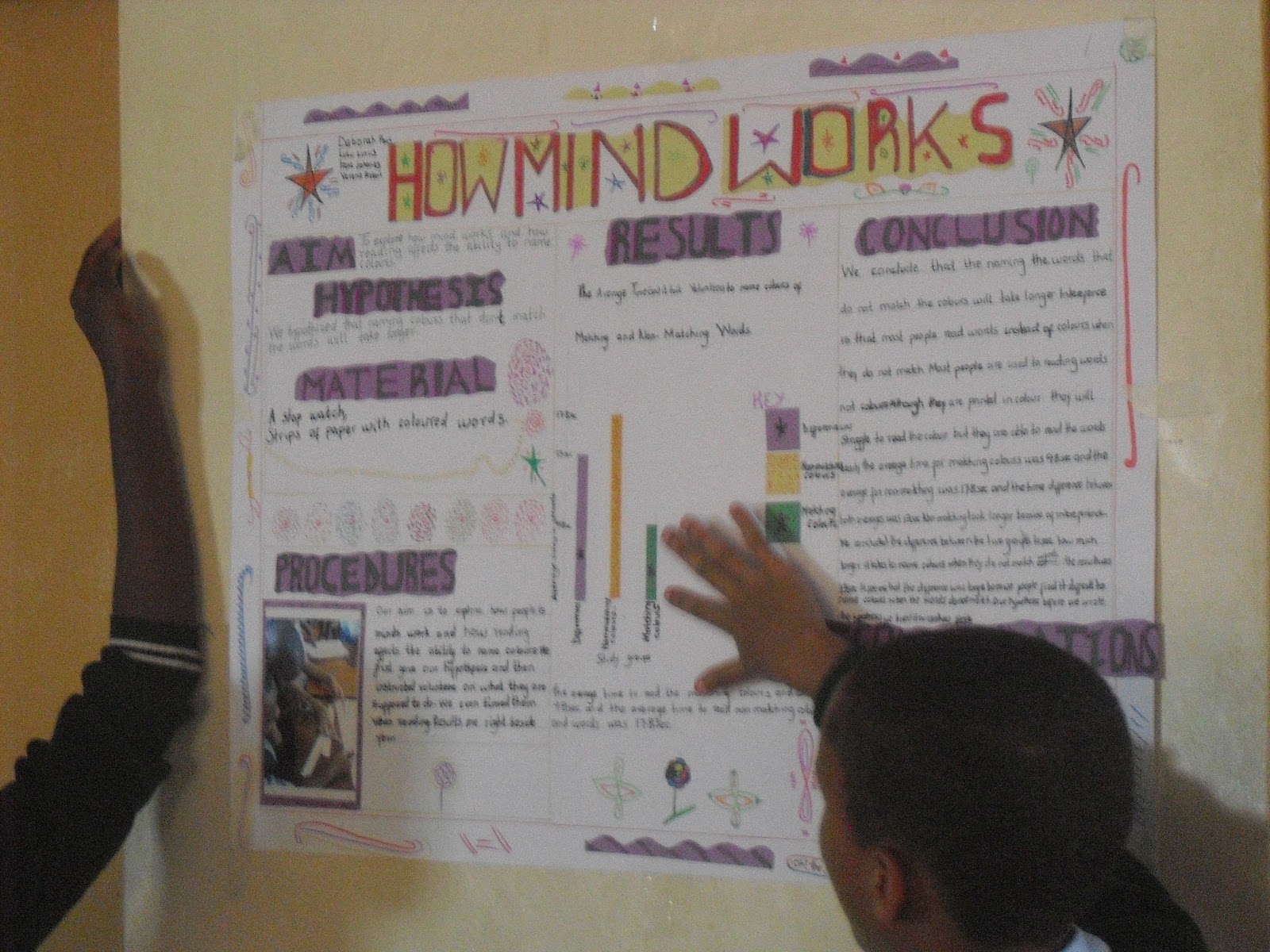
After finishing their experiments and writing their
reports, they created a poster to describe what they did and what they
found using the format of science fair posters. We worked on creating reading-friendly
posters and highlighting important information.
We also used colored markers (thank you Klaus and Mary!) to decorate and jazz up the posters.
On Wednesday afternoon students began their classroom
presentations, and they also hosted a poster fair for the teachers in order to
share what they had learned and created over the last several weeks. As I walked through the poster fair, I was
delighted to see my pupils eagerly engaged with their teachers: answering questions, demonstrating
procedures, referring to and explaining their graphs, describing what they
found and what they would like to do next.
I am so proud
of them and I hope you enjoy their work!
Putting finishing touches on their posters before the poster fair.
Our academic teacher and a pupil discuss the poster in the background.
I'm sorry this post is late! I had a wonderful long weekend in Arusha, Tanzania where Teacher Aaron, Allison and I met with other ELCA volunteers working around Tanzania. We learned about the missions of other volunteers and shared some of our own experiences from Bukoba. It was rejuvenating to connect with other Lutherans abroad, and to enjoy the comforts of a larger city.
Below you will find a short video of the newest addition to the KEMPS Sunday choirs. These girls are in Standard 1 and 2. Although they were a bit nervous, they were also very excited to perform for you!
Here is another song from the boys' kwaya umoja. They wanted to film their songs in different places around campus. This is in front of the teachers' office in our main quad.
"Ni Nani Huyo"
Refrain: Ninani ye ni nani huyo nimuonaye mtu wa nne ndani ya moto? x2
Verse 1: Abedinego na Meshaki walikuwa motoni wakimshukuru Mungu kwa Imani Pekee. x2
Verse 2: Na sisi binadamu ni watoto wa Mungu tumshukuru Mungu kwa Imani pekee. x2
"Who is that"
Refrain: Who is that, the forth person in the fire? x2
Verse 1: Abednego and Meshach were in the fire praising the Lord in faith. x2
Verse 2: And we people are children of God, so we need to praise the Lord in faith. x2
Most Sundays, I attend church at the school together with
the pupils and matrons. Entirely in
Kiswahili, it is an excellent time for me to practice my language skills. The teachers who live on campus take turns
leading the service, and as the sermons are more geared towards children, there
are Sundays every once in a while where I feel I understand something of the
message for the week.
Even more thrilling than understanding part of a sermon,
or finding the right page in my hymnal or bible, is the chance to listen to the
different choirs of pupils. There are
several girls' choirs, and one boys' choir.
All of these choirs are impressive as the pupils lead them themselves,
practice on their own time, decide on dance steps, harmonies, drumming patterns
and who will sing solos.
Today I have a
video of the boys' choir, called the Kwaya Umoja (Choir of Unity). It consists of boys from standards 3-6, and
even a standard 7 graduate who returned to campus when he heard I would like to
videotape them. It is lead by Henry in
Standard 6 who plays the guitar and also sings several solos in different
songs. I am constantly impressed that these boys can play the guitar, lead themselves, dance, sing solos
and sing in harmony! I would never catch
an American boy dancing with such confidence!
I will try to post a new song each Sunday, so tune in every Sunday for a taste of church
music Tanzanian, or KEMPS, style!
"Wanadamu"
Verse 1: Wanadamu tunayo dhiki kubwa. Maisha yetu ni ya wasiwasi.
Amani utulivu vimekwisha. Tukimbilie wapi kuokoka? x2
Refrain: Yesu anasema jipime moyo uwe na amani.
Yesu anasema ni mimi nimeushinda ulimwengu x2
Verse 2: Dunia yote ina yumbayumba. Roho za watu zinadundadunda.
Fikiria kutuvusha mawimbi kama si Yesu mwana wake Mungu.
"People"
Verse 1: People we have big problems. Our life is of worries.
Peace and harmony are over. Where should we run to save ourselves?
Refrain: Jesus says test your heart and you shall have peace.
Jesus says I am the one who won the world.
Verse 2: The whole world is staggering. Hearts of people are beating.
Think of crossing the waves if it is not Jesus the son of the Lord.
Translation by Henry, Elibariki and Yona (Standard 6).
Last week, construction resumed on the boys'
bathrooms. Thanks to many of you and your
generous donations, we watched trucks with cement, rock and other building
materials arrive on campus. Since then,
workmen have been busy cementing the floor, framing out doorways and windows, and building an entrance wall to give privacy on the exposed hilltop.
Last week, construction also took place to link the school
building rooftop to the main rainwater tank on campus. The school's running
water is extremely unreliable and instead, students and staff (myself included) rely on the rainwater collected in the tanks for
daily chores such as washing, bathing and even drinking water. Two weeks ago the large tank went dry and the
school (200 or more pupils, as well as the staff) shared one small reserve tank
for bathing, cooking and washing.
Fortunately, the rains have since returned, and with the new piping
collecting additional rainwater, there should be fewer shortages in the future.
Below are some photos of the latest construction on
campus.
My recent posts have shown that I have spent a lot of time galavanting around East Africa, and I figured it was time to share a little about the students at KEMPS as they are, after all, the reason I am here.
The past 5 weeks the school has been on holiday so that the national census could take place. As teachers are well educated, they are expected to run the census, which is why the school has been closed. However; this past week we have reopened and been busy preparing for Standard 7 Graduation which took place yesterday.
The day was filled with songs and dances from each of the classes from pre-school to Standard 7. I led Standard 1 in singing Frere Jacques complete with actions and chimes for the bells ding-donging at the end. They finished by wishing Standard 7 good luck and saying "Au revoir!" Although not quite in key, they were enthusiastic, remembered all their words and actions, and my three chime players came in right on cue.
Below are several videos from the day which show the pupils drumming, singing and dancing. The first shows two Standard 5 pupils drumming for their class entrance song. The second is of the Standard 6 exit song. The third is the school choir. In many choirs here it is common for one dancer to address the audience. The pupil who does this is in Standard 4. The last video shows pupils from different standards dancing a traditional dance called ngoma (which means "drum"). Unfortunately I don't have a video of Standard 1 as I was busy directing. Enjoy my kids!



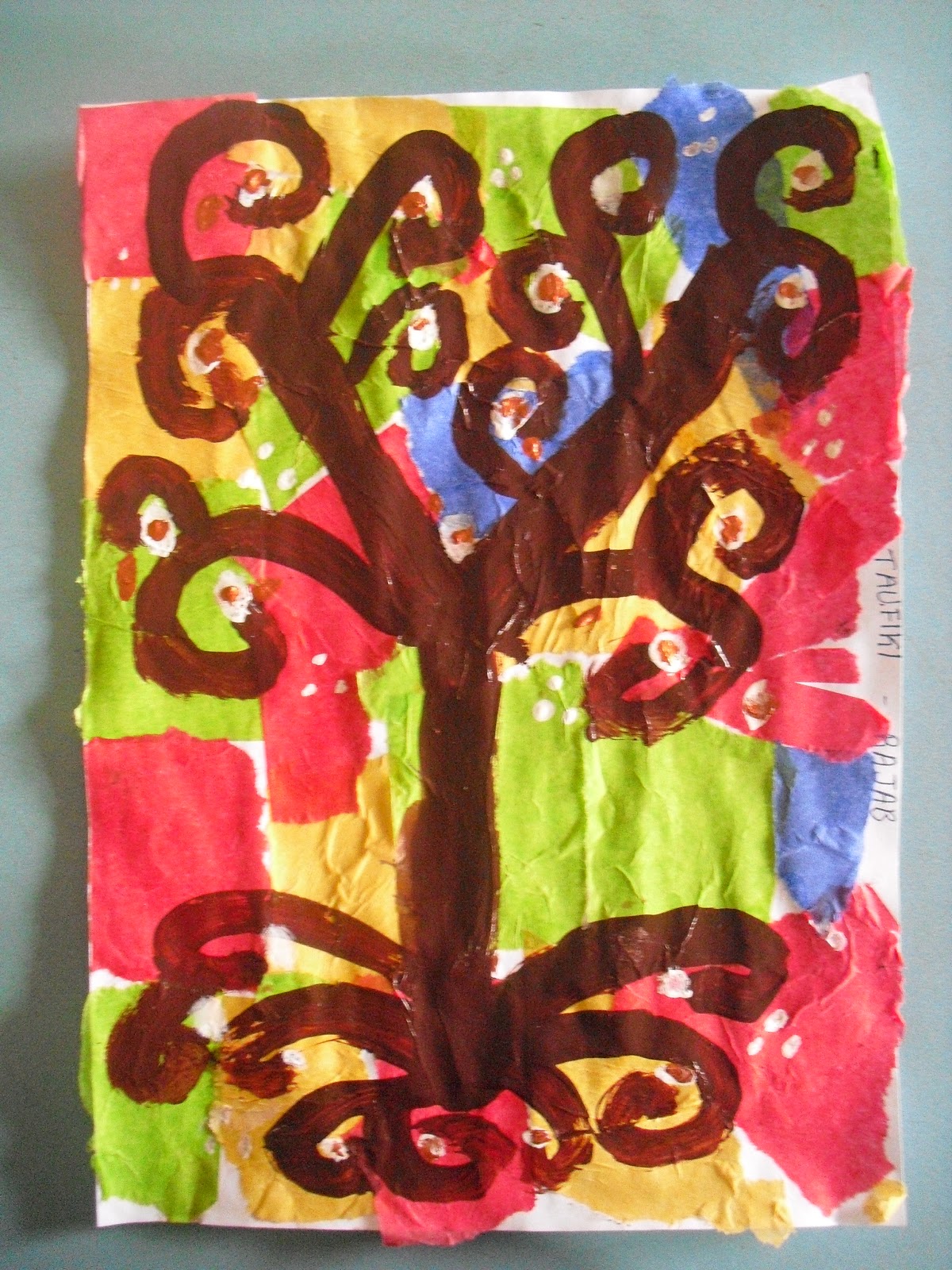
 Finished trees of life! Great colors and swirls.