Here is another song from the boys' kwaya umoja. They wanted to film their songs in different places around campus. This is in front of the teachers' office in our main quad.
"Ni Nani Huyo"
Refrain: Ninani ye ni nani huyo nimuonaye mtu wa nne ndani ya moto? x2
Verse 1: Abedinego na Meshaki walikuwa motoni wakimshukuru Mungu kwa Imani Pekee. x2
Verse 2: Na sisi binadamu ni watoto wa Mungu tumshukuru Mungu kwa Imani pekee. x2
"Who is that"
Refrain: Who is that, the forth person in the fire? x2
Verse 1: Abednego and Meshach were in the fire praising the Lord in faith. x2
Verse 2: And we people are children of God, so we need to praise the Lord in faith. x2
Most Sundays, I attend church at the school together with
the pupils and matrons. Entirely in
Kiswahili, it is an excellent time for me to practice my language skills. The teachers who live on campus take turns
leading the service, and as the sermons are more geared towards children, there
are Sundays every once in a while where I feel I understand something of the
message for the week.
Even more thrilling than understanding part of a sermon,
or finding the right page in my hymnal or bible, is the chance to listen to the
different choirs of pupils. There are
several girls' choirs, and one boys' choir.
All of these choirs are impressive as the pupils lead them themselves,
practice on their own time, decide on dance steps, harmonies, drumming patterns
and who will sing solos.
Today I have a
video of the boys' choir, called the Kwaya Umoja (Choir of Unity). It consists of boys from standards 3-6, and
even a standard 7 graduate who returned to campus when he heard I would like to
videotape them. It is lead by Henry in
Standard 6 who plays the guitar and also sings several solos in different
songs. I am constantly impressed that these boys can play the guitar, lead themselves, dance, sing solos
and sing in harmony! I would never catch
an American boy dancing with such confidence!
I will try to post a new song each Sunday, so tune in every Sunday for a taste of church
music Tanzanian, or KEMPS, style!
"Wanadamu"
Verse 1: Wanadamu tunayo dhiki kubwa. Maisha yetu ni ya wasiwasi.
Amani utulivu vimekwisha. Tukimbilie wapi kuokoka? x2
Refrain: Yesu anasema jipime moyo uwe na amani.
Yesu anasema ni mimi nimeushinda ulimwengu x2
Verse 2: Dunia yote ina yumbayumba. Roho za watu zinadundadunda.
Fikiria kutuvusha mawimbi kama si Yesu mwana wake Mungu.
"People"
Verse 1: People we have big problems. Our life is of worries.
Peace and harmony are over. Where should we run to save ourselves?
Refrain: Jesus says test your heart and you shall have peace.
Jesus says I am the one who won the world.
Verse 2: The whole world is staggering. Hearts of people are beating.
Think of crossing the waves if it is not Jesus the son of the Lord.
Translation by Henry, Elibariki and Yona (Standard 6).
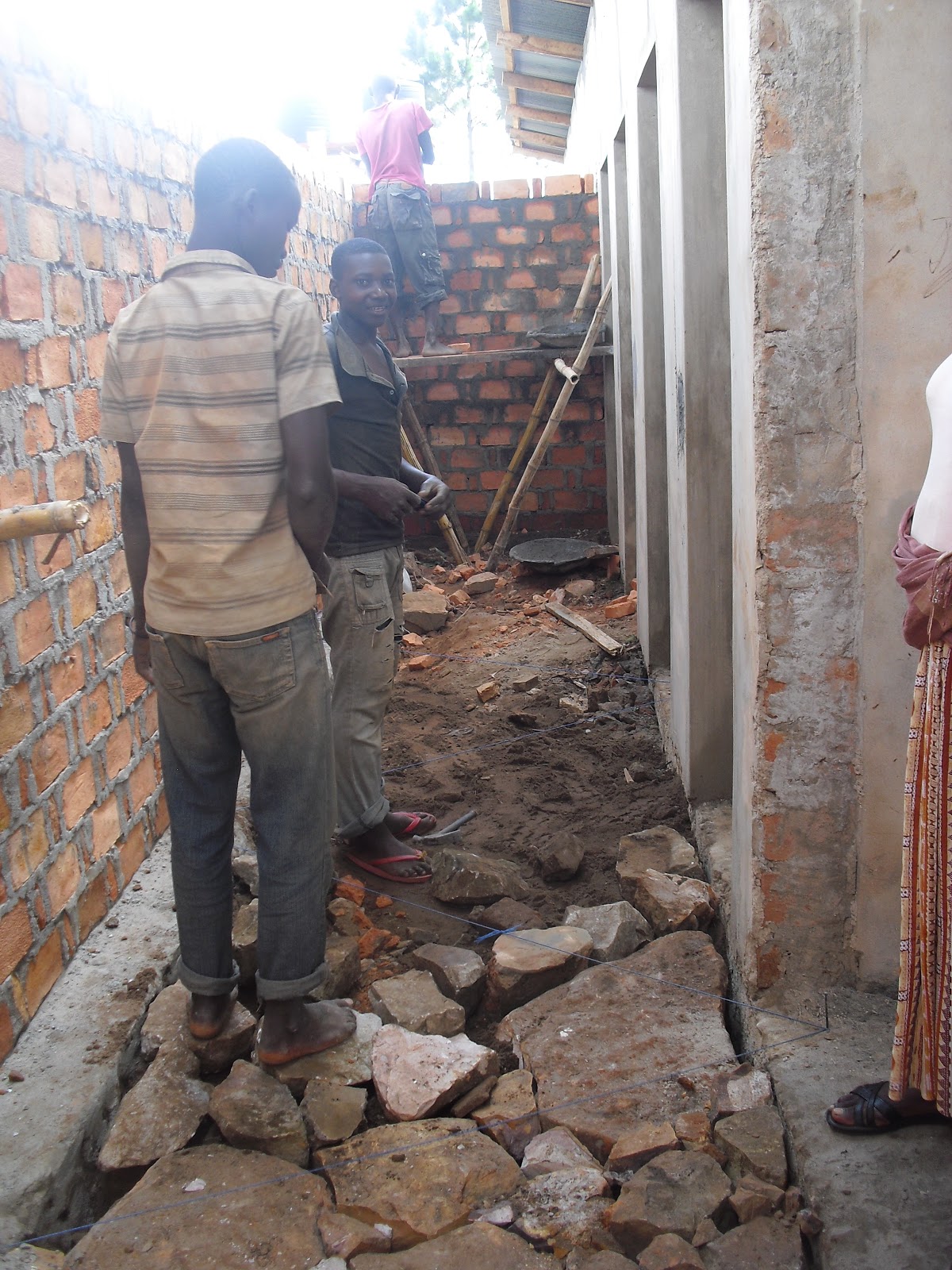
Last week, construction resumed on the boys'
bathrooms. Thanks to many of you and your
generous donations, we watched trucks with cement, rock and other building
materials arrive on campus. Since then,
workmen have been busy cementing the floor, framing out doorways and windows, and building an entrance wall to give privacy on the exposed hilltop.
Last week, construction also took place to link the school
building rooftop to the main rainwater tank on campus. The school's running
water is extremely unreliable and instead, students and staff (myself included) rely on the rainwater collected in the tanks for
daily chores such as washing, bathing and even drinking water. Two weeks ago the large tank went dry and the
school (200 or more pupils, as well as the staff) shared one small reserve tank
for bathing, cooking and washing.
Fortunately, the rains have since returned, and with the new piping
collecting additional rainwater, there should be fewer shortages in the future.
Below are some photos of the latest construction on
campus.
My recent posts have shown that I have spent a lot of time galavanting around East Africa, and I figured it was time to share a little about the students at KEMPS as they are, after all, the reason I am here.
The past 5 weeks the school has been on holiday so that the national census could take place. As teachers are well educated, they are expected to run the census, which is why the school has been closed. However; this past week we have reopened and been busy preparing for Standard 7 Graduation which took place yesterday.
The day was filled with songs and dances from each of the classes from pre-school to Standard 7. I led Standard 1 in singing Frere Jacques complete with actions and chimes for the bells ding-donging at the end. They finished by wishing Standard 7 good luck and saying "Au revoir!" Although not quite in key, they were enthusiastic, remembered all their words and actions, and my three chime players came in right on cue.
Below are several videos from the day which show the pupils drumming, singing and dancing. The first shows two Standard 5 pupils drumming for their class entrance song. The second is of the Standard 6 exit song. The third is the school choir. In many choirs here it is common for one dancer to address the audience. The pupil who does this is in Standard 4. The last video shows pupils from different standards dancing a traditional dance called ngoma (which means "drum"). Unfortunately I don't have a video of Standard 1 as I was busy directing. Enjoy my kids!
The mountain Gorillas of Dian Fossey have always had a
certain aura of mystery about them. They
live in the foothills of Volcanoes National Park which are often engulfed in
mist. The roads to reach the different
groups are rough lava rocks. The paths
to trek the gorillas are equally non-existent.
Our guide used a machete to cut a path through extremely tall and vicious
stinging nettles. All of us were
wondering if the gorillas would ever appear when one slowly came lumbering into
view. The male silverback was followed
by a mother carrying twins and a mother with a newborn less than a month old. As we followed the gorillas and peered through
the brush, we were surrounded by the pleasantly busy sound of tearing and
chomping as the gorillas pulled down stalks of plants, stripped them and ate
the interior.
Enjoy the photos and video below of the gorillas we observed. Pay particular attention in the video to catch a glimpse of the newborn!
Sunset over the volcanoes.
Our hike began with a wonderful stroll through the
bamboo forest along a stream.
Our trail through the nettles. Can you see it?!
Mama and baby give us a look as we watch them eating.
This silverback is stripping the outer part of the the stalk before eating
the rest. After eating, he came walking right past us while we
scrambled into the stinging nettles to get out of the way.
The Susa group has three silverbacks. This is the 3rd silverback and the
lowest in rank. One of the most impressive things was observing the length
of their arms and the size of their fingers.
Posing for the camera.
Unfortunately I did not get a picture as the male silverback
walked past; however this time I was ready, both to jump
into the brush and to take a picture!
They were close. I was a bit nervous to face the camera instead of keeping
my eye on the Gorilla.
Moto woke us up on summit night at 11pm. After putting on an extraordinary amount of
clothing, we grabbed a quick bite to eat and made sure our day bags were ready.
At 12:15am we began the pole pole
ascent. We joined the procession of
hikers whose twinkling headlamps could be seen stretching in zigzag lines up
the slopes of the mountain.
For the next six and a half hours we focused on putting
one foot in front of the other. We
slowly passed groups. The camaraderie among
all climbers was high as people asked "Are we there yet?" to the
laughter of all climbers within earshot.
The endless switchbacks continued up and up, the frozen skree getting
deeper the higher we climbed. Many hours
later, we paused for a break. There were
only a few headlamps ahead of us.
Looking down the mountain into the clear night sky we could see all the
lights of Moshi on the plains. On the
left, a sliver of red moon was rising.
Above, thousands of stars shone in the sky. Still we climbed up. For each small step forward, we breathed in
and out, in and out. It was like running
a long distance race for each step forward.
The skree deepened and finally Tumaini, our guide,
announced that we were half an hour from Stella Point. Breathing hard, it was still dark when we
reached it. The faintest lightening of
the sky was visible along the horizon. After
a short rest during which I wanted nothing more than to close my eyes and
sleep, we continued up to Uhuru Peak. At
6:30am in the morning we arrived. It was
freezing and windy, and I was out of breath, but we had made it. We watched the last of the sunrise from the
tallest point of Africa. Mawenzi was silhouetted,
its black peaks jagged against the morning sky, and the glaciers looked
foreboding and beautiful as they caught the first light. I felt on top of the
world, and more awed than ever by the dangerous beauty of the natural world in
which we live.
Unfortunately, what comes up, must come down. We spent the next several hours pounding our knees as we slid down the skree slopes back to camp. By the time we arrived, we had been walking for 10 hours. An hour rest and lunch later, we were packing up and walking down again. By 6pm we were at Mweka Camp, a mere 3080 meters as opposed to the 5895 meters of Uhuru Peak. The next morning, our trip ended with a surprisingly good Tanzanian cheeseburger and the presentation of our certificates which stated that we successfully climbed Mount Kilimanjaro, the Highest Mountain in Africa.
Our acclimatization hike the afternoon before our summit climb. Mawenzi is in the distance.
Sunrise from Uhuru Peak at 5895m.
I think the picture says it all!
Eerie looking glaciers in front of Mount Meru.
Looking into the crater at the top of Mount Kilimanjaro.
Mawenzi in the distance as climbers walk towards Uhuru Peak past the glaciers.
Amazed to be back in the heather and moorland zone when a few hours before we were standing on that snowy peak above our heads!
The last view of Kibo through the dense canopy of the rainforest as we walk down to Mweka Gate.
The adventure is officially over, which, although sad and disappointing, does mean that hot showers are just around the corner!
The sound of people moving around camp woke me up early at
Barranco Camp. After a big stretch, I
paused in my sleeping bag and listened carefully - there was no pitter pat of
rain! Jumping out of bed in my fleece pants
and down jacket, I left Natacha sleeping in order to see what camp really
looked like when not obscured by rain and mist.
Everyone was excited that morning, partly because it was
sunny, but also because today we were tackling the Barranco Wall, also known as
the Breakfast wall - the imaginative name it acquired because it is usually
tackled after breakfast. This climb
broke the slight monotony of the pole pole of the past few days. Carefully placing feet and hands, we scaled
the valley wall. We passed the kissing
rock, so named because you had to place your hands in a bear hug position, hug
the rock and edge across a narrow ledge that had an impressive view down if you
we brave (or stupid) enough to look. The
views from the top were well worth the effort of the climb. From the flat ledges at the top you could see
the banks of clouds spread below, Mount Meru emerging hazy from them and
darkening to a deep mountain blue at the peak.
Behind, Kibo felt so close that I wanted to reach out my hand and touch
it.
Continuing on, we passed a second grove of tree groundsel
(see the picture below) and through the Karanga valley. The cold water was the last water on the way
to the summit. Karanga camp was a
windswept camp on the mountainside brightened by the views of Meru and the colorful
tents of different companies flapping in the wind.
The next day we hiked to Barafu (Kiswahili for "ice")
camp, our base camp for attempting the summit.
The way there was barren desert and would have been silent except for
the flat rocks that lined the trail. As boots
passed over the rock pieces, they clinked together sounding like wind chimes
blowing in the wind. Barafu camp itself
was perched at the edge of a cliff, the different tents nestled among the
boulders. We prepared our packs and gear
in the afternoon and tried to snatch some sleep as our minds focused fretfully
on the summit night a couple of hours away.
The view up Barranco Valley towards Kibo.
Working our way slowly up the Breakfast Wall.
At the top of the Barranco Wall. Kibo is so close,
but so far.
One of our group members looks out towards Mount Meru from the top of
the Barranco Wall.
I feel like a midget next to this huge tree groundsel.